


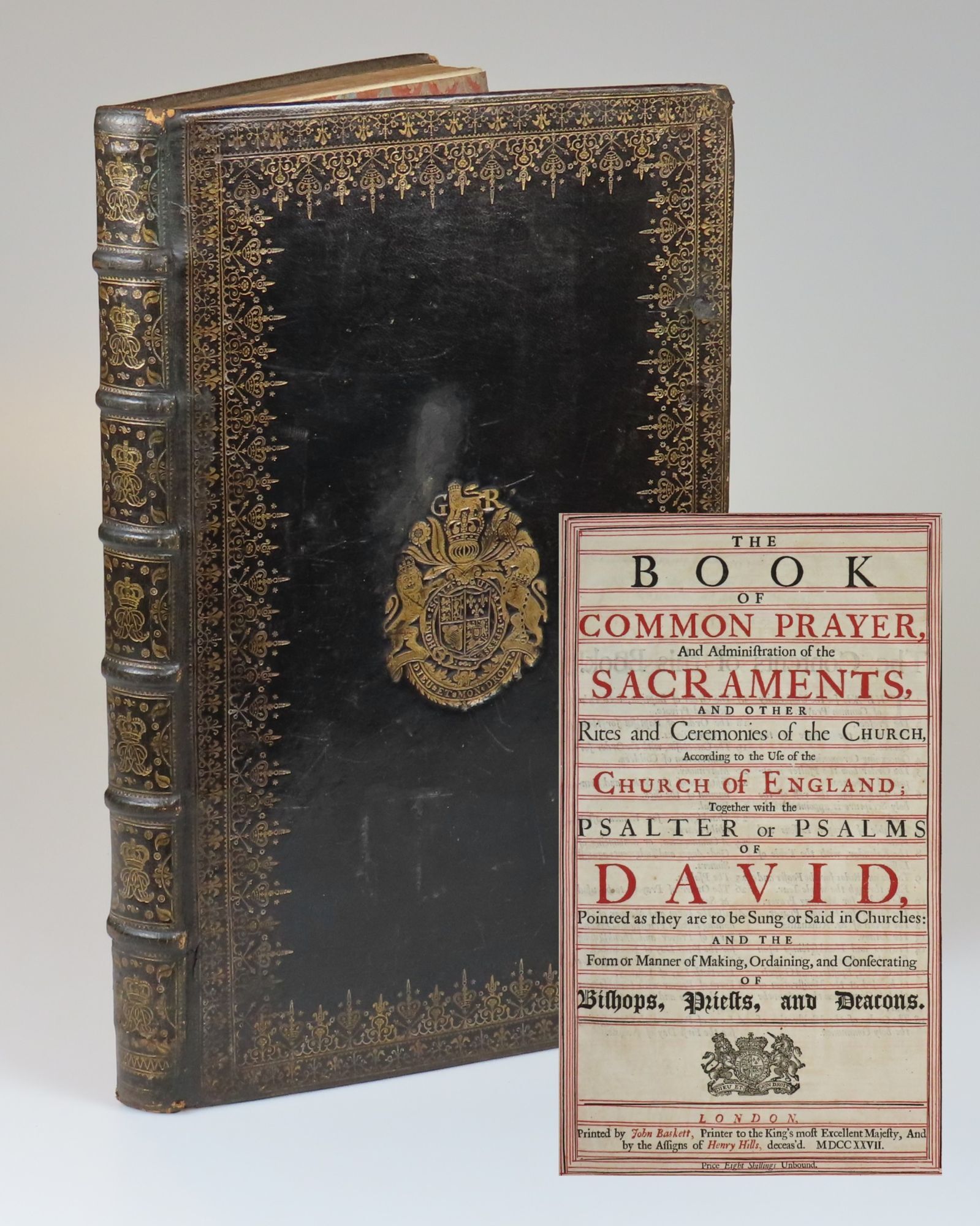
The Book of Common Prayer, a beautiful folio edition in a contemporary eighteenth century royal Georgian binding.
and Administration of the Sacraments, and Other Rites and Ceremonies of the Church, According to the Use of the Church of England, together with the Psalter or Psalms of David, Pointed as they are to be Sung or Said in Churches: and The Form or Manner of Making, Ordaining, and Consecrating of Bishops, Priests, and Deacons
London: Printed by John Baskett, Printer to the King's most Excellent Majesty, 1727. Full leather. This large 1727 folio publication of the Book of Common Prayer retains its exceptional, original early Georgian royal binding. The full dark brown calf features, centered on both covers, the gilt-stamped royal arms that belonged to both George I (1714-1727) and George II (1727-1760), as well as George III until 1801 (when George III became King of the United Kingdom instead of King of Great Britain). The balance of the binding features an elaborately gilt-decorated spine with royal monograms in each spine compartment. The covers feature broad, elaborately gilt-tooled borders. The cover edges are gilt-tooled. The contents are bound with gilt-tooled turn-ins framing marbled endpapers, with engraved frontispiece depicting a neo-classical, domed church building, woodcut head and tailpieces, and historiated initials. The text is printed in double columns of large type, hand-ruled throughout. The volume is physically substantial, measuring 16.25 x 10.25 x 1.5 inches and weighing 5.5 pounds. Printing of the Book of Common Prayer (and Bibles) was restricted to the King's printer and the presses of Cambridge and Oxford Universities. The printer of this book, John Baskett (1666-1742), was both the King's printer and the printer of Oxford University.
The lovely binding is quite clean and sound, with expected superficial scuffs and wear to the corners. The original linen ties are absent, the stubs evident at two points on each upper and lower front cover near the fore edges. The contents are quite crisp and clean overall. A previous owner name, “Margaret Burgis | her book | August 7th | 1762” is inked in large, beautiful, bordered calligraphy on the recto of the blank preceding the frontispiece.
Significantly, given the royal binding and provenance, the Prayer for the Royal Family on leaf B1 bears correction slips reflecting the accession of George III. In the correction, “Charlotte,” is pasted over “Caroline”, the balance of the correction reading "her Royal Highness, the Princess Dowager of Wales,” which precedes the printed “the Royal Family:”. Caroline of Ansbach became Queen upon the accession of her husband, George II, in 1727, remaining Queen until her death in 1737. (Hence printing of this book in 1727 must have occurred later in the year, after the 11 June 1727 death of George I.) Charlotte of Mecklenburg-Strelitz, wife of George III, became Queen upon her 1761 marriage to George III, remaining so until her death in 1818. We can date this correction to between 1751 and 1772 due to the reference to “the Princess Dowager of Wales". George III was the grandson of George II. George III’s father, Frederick Prince of Wales, the son of George II, died in 1751 before his father, rendering Frederick’s wife, Augusta of Saxe-Gotha, the Dowager Princess of Wales until her own death in 1772.
It seems likely that the royal binding was commissioned upon or soon after publication in 1727. It seems certain that the binding was commissioned no later than 1760, since the binding would have almost certainly pre-dated the correction of the contents therein, necessitated by the 1760 accession of George III.
Few books can claim such royal provenance, given that the Book of Common Prayer owed its genesis to the fortunes and favor of the English throne.
“The English Book of Common Prayer was the first single manual of worship in a vernacular language directed to be used universally by, and common to, both priest and people.” Since it was first published in 1549, “it has been a source of spiritual inspiration in England second only to the Bible.” The man responsible for conception of the Book of Common Prayer, Thomas Cranmer (1489-1556) was appointed Archbishop of Canterbury by the famously reproductively frustrated Henry VIII in 1533.
This began an unusual relationship wherein Cranmer and the king used one another to further their respective ambitions. The king went through a series of marriages and divorces and sought Cranmer’s assistance in granting permission, while Cranmer used his newfound religious influence to embrace and promote Reformation ideals.
Cranmer’s greatest achievement came in 1549, with publication of the Book of Common Prayer. Crammer and a commission of twelve bishops and dignitaries compiled a prayer book drawing from various sources, including the Bible itself, traditional Catholicism, continental Protestantism in “a multiple departure from medieval precedent.” Not only was it compiled in English rather than Latin, but it also replaced seven distinct medieval books which had been “known and used almost exclusively by the clergy. The name of the book was to be taken literally: it was to be a Book of Common Prayer; as useful to any layman as to the bishops and clergy themselves.”
Cranmer was burned at the stake in 1556 by order of the Roman Catholic Queen “Bloody” Mary. His Book of Common Prayer proved less inflammatory and remains an incredibly influential devotional, at the heart of Anglican worship and influencing English-speaking Christians across many traditions.
Sources: Griffiths, The Bibliography of the Book of Common Prayer; Printing and the Mind of Man; Oxford Dictionary of National Biography. Item #008384
Price: $3,000.00