

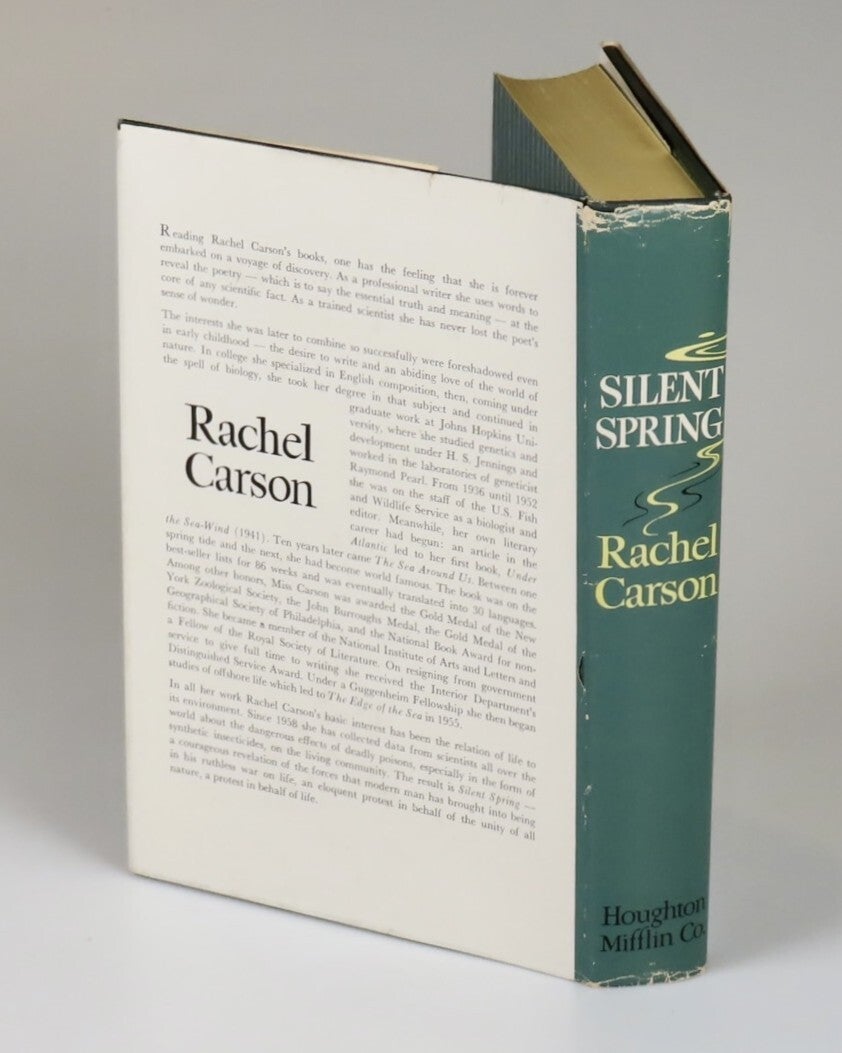


Silent Spring.
Boston: Houghton Mifflin Co., 1962. First edition, first printing. Hardcover. This is an exceptional copy of the first edition, first printing of the work "generally credited as being the fountainhead of the environmental movement." Condition is better than near fine in a near fine dust jacket. The publisher's dark green cloth binding is square, clean, tight, and unfaded with sharp corners, bright gilt, and only minor shelf wear to extremities. The contents are immaculate and retain a crisp, unread feel, with no previous ownership marks, no spotting, no discernible age-toning, and retaining uniformly bright yellow topstain. The dust jacket is unclipped, retaining the original "$5.00" front flap price, and substantially complete, with only miniscule loss at the spine head. Color is excellent, with only a barely discernible hint of color shift in the yellow print on the spine and front cover and a clean, bright white rear panel. The jacket shows light shelf wear and a few tiny closed tears to the extremities, as well as a tiny closed tear just below the mid-point of the rear joint below. The dust jacket is protected beneath a clear, removable archival cover.
It was clear from the start that Rachel Louise Carson (1907-1964) was gifted. That she would spend the final energies of her short life as a profoundly influential catalyst for environmental awareness and protection was not.
Carson was not only conspicuously talented as a writer, but also "single-minded about preparing for a career in science at a time when very few women could find professional positions." She ended up with the agency that became the U.S. Fish and Wildlife Service, where she eventually became editor of all agency publications and where she was working when she expanded an Atlantic Monthly essay she had written for the government into a 1941 book called Under the Sea-Wind. Hailed by scientists, the book was commercially limited by the Second World War. This was not the case when she published The Sea Around Us in 1951, which "was serialized in the New Yorker, where it captivated scientists and the public alike" and which "remained on the New York Times bestseller list for a record eighty-six weeks. Carson was retired in Maine when she wrote her third and last seas work, The Edge of the Sea, in 1955, which was also a bestseller.
Then, with less than a decade left in her life, her literary nous, scientific background, Fish and Wildlife experience, and love of the natural world took led her unexpectedly to launch a crusade, warning of the potential for ecological disaster as a result of the careless misuse of chemical pesticides. The book she proposed in 1958 to her Houghton Mifflin editor as "The Control of Nature" became 1962's Silent Spring, which "indicted the chemical industry, the government, and agribusiness for indiscriminately using pesticides without knowing more about their long-term effects." The book, serialized by the New Yorker in advance of publication, "caused a sensation." Both "the scientific establishment" and the agrichemical industry attacked her in a major publicity campaign as both an hysterical woman and a poor scientist. But the public took note of her work, and President John F. Kennedy called for an investigation. Carson testified before the U.S. Senate and the public called for federal regulation. Carson was acclaimed by the public and received numerous scientific and literary awards. But she died just eighteen months after publication of Silent Spring, living just long enough to see the initial efficacy of her work.
References: ANB. Item #008545
Price: $1,000.00